

Why Independence Takes Longer With NVLD
Learning life skills on a different timeline without feeling ashamed

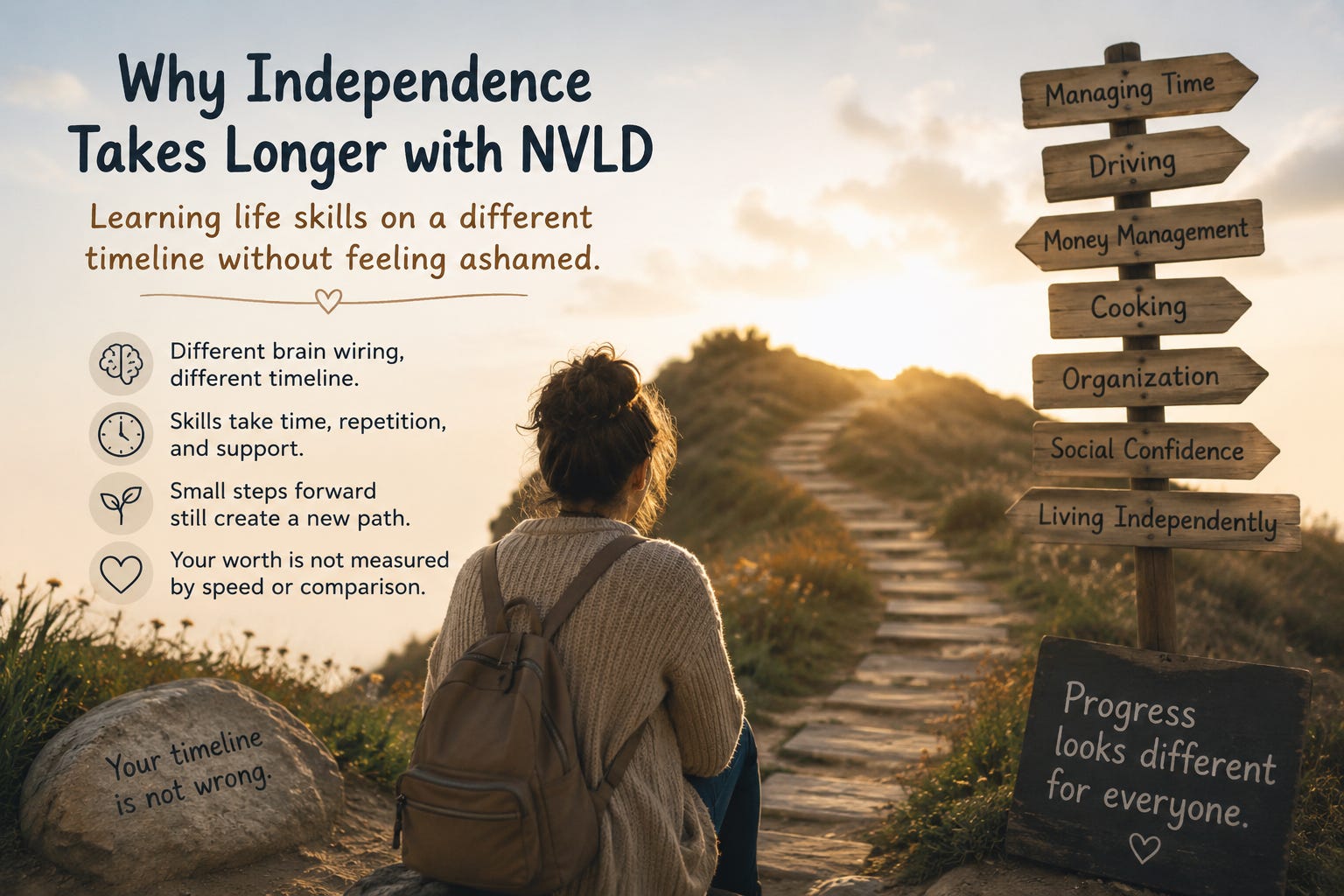
One of the hardest parts of living with Nonverbal Learning Disorder/NVLD, also known as Developmental Visual-Spatial Disorder (DVSD), isn’t just the disability itself–it’s feeling like you’re constantly behind everyone else. While your peers may be learning to drive, starting careers, moving out, or managing adult responsibilities with relative ease, you may still be struggling with skills that other people assume are simple or have mastered long before you have. This can lead to feelings of embarrassment, frustration, and even failure.
However, even with the negative feelings that come with being behind, it is important to remember that needing more time doesn’t mean you’re lazy, incapable, or not trying hard enough. It just means that your brain develops certain skills differently, which is part of being neurodivergent.
Why Is Gaining Independence So Hard & Takes Longer?
This is a question you likely have asked yourself if you’re a struggling adult with NVLD. The answer is that many of the skills required for independent adulthood rely heavily on abilities commonly affected by NVLD.
Executive functioning helps us plan, organize, prioritize, manage time, and complete tasks without becoming overwhelmed. Visual-spatial skills allow us to navigate unfamiliar places, judge distances, interpret visual information, and understand how objects relate to each other in space. Motor coordination affects activities such as driving, cooking, handwriting, and many everyday tasks.
When these areas are compromised, everyday life naturally becomes more challenging. Tasks that seem automatic to other people often require significantly more mental effort for someone with NVLD.
Independence Is More Than Just Living Alone
When people think of independence, they often think of things like moving out, getting a driver’s license, or working full time. However, independence is made up of hundreds of smaller skills.
For someone with NVLD, these skills may include: learning to use public transportation confidently, managing appointments and schedules, budgeting and paying bills on time, cooking meals safely, keeping a home organized, learning new workplace routines, driving or navigating unfamiliar places, or managing paperwork and other responsibilities.
These skills are often achievable, but may require more time, repetition, support, and practice.
Comparison Creates Shame
One of the biggest sources of pain for many adults with NVLD is comparison. Society expects the same milestones from everyone at roughly the same age. When that doesn’t happen, it’s extremely easy to believe that you’ve failed or there’s something wrong with you as a person.
The reality is that developmental timelines are not the same for everyone. Just like some people need glasses to see or hearing aids to hear, others need extra time to develop executive functioning, social understanding, or practical life skills. Neither reflects a person’s intelligence nor worth.
Progress Is Still Progress
Taking longer to become independent doesn’t mean independence is impossible. Many people with NVLD gradually build the skills they need over time. They often succeed by breaking tasks into smaller steps, practicing repeatedly, using written checklists, asking for accommodations, or receiving coaching and support.
There is no deadline for learning how to live independently, but support from family and friends often makes a huge difference in learning these skills and feeling better about oneself.
Be Kind To Yourself
Living with NVLD means navigating a world that wasn’t designed for the way your brain processes information. That can make everyday tasks exhausting in ways that others don’t see.
If your journey toward independence has taken longer than you expected, you are not alone. Your timeline may be different, but not wrong. The goal isn’t to reach milestones when society expects you to. The goal is to build a life that works for you.